Yo (kana)
| yo | |||
|---|---|---|---|
| |||
| Transliteration | yo | ||
| Hiragana origin | 与 | ||
| Katakana origin | 與 | ||
| Man'yōgana | 用 容 欲 夜 与 余 四 世 代 吉 | ||
| Spelling kana | 吉野のヨ Yoshino no "yo" | ||
| Unicode | U+3088, U+30E8 | ||
| Braille | 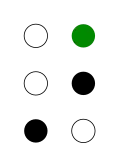 | ||
| Note: These Man'yōgana originally represented morae with one of two different vowel sounds, which merged in later pronunciation | |||
| kana gojūon | ||||||||||||||||||||||||||||||||||||||||||||||||||||||||||||
|---|---|---|---|---|---|---|---|---|---|---|---|---|---|---|---|---|---|---|---|---|---|---|---|---|---|---|---|---|---|---|---|---|---|---|---|---|---|---|---|---|---|---|---|---|---|---|---|---|---|---|---|---|---|---|---|---|---|---|---|---|
|
||||||||||||||||||||||||||||||||||||||||||||||||||||||||||||
| Kana modifiers and marks | ||||||||||||||||||||||||||||||||||||||||||||||||||||||||||||
| Multi-moraic kana | ||||||||||||||||||||||||||||||||||||||||||||||||||||||||||||
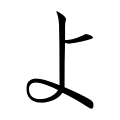
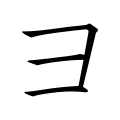
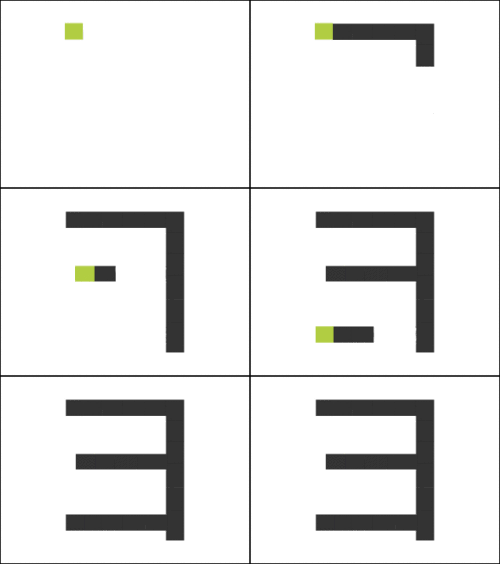
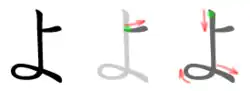
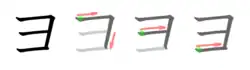
よ, in hiragana or ヨ in katakana, is one of the Japanese kana, each of which represents one mora. The hiragana is made in two strokes, while the katakana in three. Both represent [jo].
When small and preceded by an -i kana, this kana represents a palatalization of the preceding consonant sound with the [o] vowel (see yōon).[1]
In mathematics, よ is sometimes used to represent the Yoneda embedding.[2]
| Forms | Rōmaji | Hiragana | Katakana |
|---|---|---|---|
| Normal y- (や行 ya-gyō) |
yo | よ | ヨ |
| you yoo yō |
よう, よぅ よお, よぉ よー |
ヨウ, ヨゥ ヨオ, ヨォ ヨー |
Stroke order
 |
 |
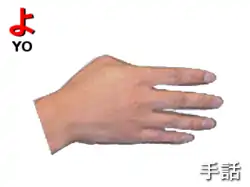
Other communicative representations
| Japanese radiotelephony alphabet | Wabun code |
| 吉野のヨ Yoshino no "Yo" |
ⓘ |

|
|
|
|
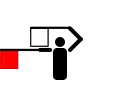
| Japanese Navy Signal Flag | Japanese semaphore | Japanese manual syllabary (fingerspelling) | Braille dots-345 Japanese Braille |

- Full Braille representation
| よ / ヨ in Japanese Braille | ||||
|---|---|---|---|---|
| よ / ヨ yo |
よう / ヨー yō |
ょ/ョ Yōon* |
゛ょ/゛ョ Dakuten + Yōon* |
゜ょ/゜ョ Handakuten + Yōon* |
|
 |
 |
 |

|
* The yōon characters ょ and ョ are encoded in Japanese Braille by prefixing "-o" kana (e.g. Ko, So) with a yōon braille indicator, which can be combined with the "Dakuten" or "Handakuten" braille indicators for the appropriate consonant sounds.
| Preview | よ | ヨ | ヨ | ㋵ | ||||
|---|---|---|---|---|---|---|---|---|
| Unicode name | HIRAGANA LETTER YO | KATAKANA LETTER YO | HALFWIDTH KATAKANA LETTER YO | CIRCLED KATAKANA YO | ||||
| Encodings | decimal | hex | dec | hex | dec | hex | dec | hex |
| Unicode | 12424 | U+3088 | 12520 | U+30E8 | 65430 | U+FF96 | 13045 | U+32F5 |
| UTF-8 | 227 130 136 | E3 82 88 | 227 131 168 | E3 83 A8 | 239 190 150 | EF BE 96 | 227 139 181 | E3 8B B5 |
| Numeric character reference | よ |
よ |
ヨ |
ヨ |
ヨ |
ヨ |
㋵ |
㋵ |
| Shift JIS[3] | 130 230 | 82 E6 | 131 136 | 83 88 | 214 | D6 | ||
| EUC-JP[4] | 164 232 | A4 E8 | 165 232 | A5 E8 | 142 214 | 8E D6 | ||
| GB 18030[5] | 164 232 | A4 E8 | 165 232 | A5 E8 | 132 49 155 48 | 84 31 9B 30 | ||
| EUC-KR[6] / UHC[7] | 170 232 | AA E8 | 171 232 | AB E8 | ||||
| Big5 (non-ETEN kana)[8] | 198 236 | C6 EC | 199 162 | C7 A2 | ||||
| Big5 (ETEN / HKSCS)[9] | 199 111 | C7 6F | 199 228 | C7 E4 | ||||
| Preview | ょ | ョ | ョ | |||
|---|---|---|---|---|---|---|
| Unicode name | HIRAGANA LETTER SMALL YO | KATAKANA LETTER SMALL YO | HALFWIDTH KATAKANA LETTER SMALL YO | |||
| Encodings | decimal | hex | dec | hex | dec | hex |
| Unicode | 12423 | U+3087 | 12519 | U+30E7 | 65390 | U+FF6E |
| UTF-8 | 227 130 135 | E3 82 87 | 227 131 167 | E3 83 A7 | 239 189 174 | EF BD AE |
| Numeric character reference | ょ |
ょ |
ョ |
ョ |
ョ |
ョ |
| Shift JIS[3] | 130 229 | 82 E5 | 131 135 | 83 87 | 174 | AE |
| EUC-JP[4] | 164 231 | A4 E7 | 165 231 | A5 E7 | 142 174 | 8E AE |
| GB 18030[5] | 164 231 | A4 E7 | 165 231 | A5 E7 | 132 49 151 48 | 84 31 97 30 |
| EUC-KR[6] / UHC[7] | 170 231 | AA E7 | 171 231 | AB E7 | ||
| Big5 (non-ETEN kana)[8] | 198 235 | C6 EB | 199 161 | C7 A1 | ||
| Big5 (ETEN/> / HKSCS)[9] | 199 110 | C7 6E | 199 227 | C7 E3 | ||
References
- ^ Jim Gleeson (2013). "Contracted sounds". Japanese Hiragana: An Introductory Japanese Language Workbook. Tuttle Publishing. ISBN 9781462913978.
- ^ "Yoneda embedding". nLab. Retrieved 6 July 2019.
- ^ a b Unicode Consortium (2015-12-02) [1994-03-08]. "Shift-JIS to Unicode".
- ^ a b Unicode Consortium; IBM. "EUC-JP-2007". International Components for Unicode.
- ^ a b Standardization Administration of China (SAC) (2005-11-18). GB 18030-2005: Information Technology—Chinese coded character set.
- ^ a b Unicode Consortium; IBM. "IBM-970". International Components for Unicode.
- ^ a b Steele, Shawn (2000). "cp949 to Unicode table". Microsoft / Unicode Consortium.
- ^ a b Unicode Consortium (2015-12-02) [1994-02-11]. "BIG5 to Unicode table (complete)".
- ^ a b van Kesteren, Anne. "big5". Encoding Standard. WHATWG.
